Wednesday, 4 May 2022

Why you need to start your retirement strategy now


No matter if you are 50, 55 or 60+, there are important strategies you can be considering now in preparation for retirement.

Key considerations in the lead up to retirement:

  • Understanding the pivotal point of when to contribute to superannuation vs debt repayments or investments outside of superannuation.
  • While debt repayments or savings/investments can be crucial in the lead up to retirement, the benefits of timing where to place your funds to maximise your position can have a significant impact on your finances in the long term.
  • What needs to be considered:
    • Outstanding debt
    • Wealth accumulation investment strategies
    • Strategies to reduce your taxable income
    • How will you get paid in retirement, investments inside superannuation, outside superannuation, age pension entitlements or a mixture? How much will you need and what strategies can you put in place now to maintain your lifestyle throughout retirement

Our most common enquiries:

  • How much money will I need in retirement?
  • Where will my money come from?
  • Will I have enough money to lead the lifestyle of my choice in retirement, am I at risk of my money running out?
  • Don’t I just withdrawal all my superannuation when I retire?
  • Can I afford to help my children?
  • Should I be purchasing investment properties or should I consider other investments inside or outside superannuation?
  • When can I access my superannuation tax free?
  • Will I be entitled to social security payments to supplement my income from superannuation and other savings?
  • Do I still need to hold my personal insurances, at what point will I be able to self-insure?
  • I haven’t even considered retirement, it seems so far away and I’m not sure at what point I will be able to retire.
Retirement planning is about practical strategies to help you lead the lifestyle of choice in retirement. Whether you have sufficient money for retirement is an issue for most people as this will impact when you can retire. Whatever the goal, prudent retirement planning should ensure that investments, including allocation of assets, are appropriate to your personal needs in tax-effective structures. It should consider ways to maximise social security benefits and the value of both superannuation and non-superannuation assets.

Australia has a three-pillar structure when it comes to retirement income:

  • the government-funded age pension
  • compulsory saving through the superannuation guarantee and
  • voluntary superannuation savings
Superannuation is a tax-advantaged saving vehicle used for saving for retirement. It also provides tax-effective income and growth after retirement. Social security benefits alone may be insufficient to provide for the lifestyle that many people desire in retirement. However, a great number of people use the social security system to supplement the income available from their superannuation and other savings.

When to speak to your adviser?

  • Inheritance / windfall
  • Considering retirement
  • Understanding when to pay down debt vs make additional contributions to super
  • Upsizing or downsizing
  • Change of circumstances
We recommend that everyone puts a financial plan in place, the earlier the better, allowing time to put effective strategies in place.

General Advice Warning

This information has been prepared and provided without taking into account your objectives, financial situation or needs. Before acting on this information, you should consider its appropriateness (having regard to your objectives, financial situation and needs) and any other information pertaining to the relevant product by referring to its PDS.

2022 Federal Budget summary


Budget update 2022

Last night, 29 March 2022, the Federal Treasurer handed down the Government’s last Budget before the Federal Election is to be called.

As expected, it includes plenty of 'sweeteners' to encourage the electorate to consider the incumbent government in a favourable light come election day, due to be held by 21 May 2022, at the latest.

Download Budget Summary

The analysis looks at areas of interest including the state of the economy, the fiscal outlook, superannuation, taxation, and welfare measures.

It goes without saying the Budget announcements are not a fait accompli. They are subject to the successful passage of legislation, which will not be passed until after the election. And that assumes the current government is returned to form the 47th Parliament.

General Advice Warning

This information has been prepared and provided without taking into account your objectives, financial situation or needs. Before acting on this information, you should consider its appropriateness (having regard to your objectives, financial situation and needs) and any other information pertaining to the relevant product by referring to its PDS.

Long COVID and life insurance – A global perspective


With WA's covid case numbers continuing to rise, we are understandably being inundated with questions about Covid protection under exisiting insurance policies. As a result of this, we would like to share an interesting article regarding Long COVID and life insurance:

"With surging cases of the COVID-19 Omicron variant, Australian insurers are likely to see more Long COVID claims in the future.

According to research from the Swiss Re Institute collected from studies in the UK and China, around 5 to 10 per cent of those infected with COVID will carry symptoms three months after initial infection, while three quarters of those hospitalised with COVID report symptoms six months after they were first infected." Click here to continue reading

Are you protected against illness or death related to Covid vaccinations or Covid itself?

In short, if you have retail advised insurance that has been underwritten, yes you are. Australian insurers registered with the Financial Services Council (FSC) code of practice and will honour Covid related claims. A list of the insurers can be found here as well as their media release guaranteeing Covid cover. Note that Industry Super Fund insurance ('group cover') can legally change the Terms and Conditions of policies retrospectively and may choose to limit cover as a result of Covid.

General Advice Warning

This information has been prepared and provided without taking into account your objectives, financial situation or needs. Before acting on this information, you should consider its appropriateness (having regard to your objectives, financial situation and needs) and any other information pertaining to the relevant product by referring to its PDS.


Geopolitical tensions and your investments

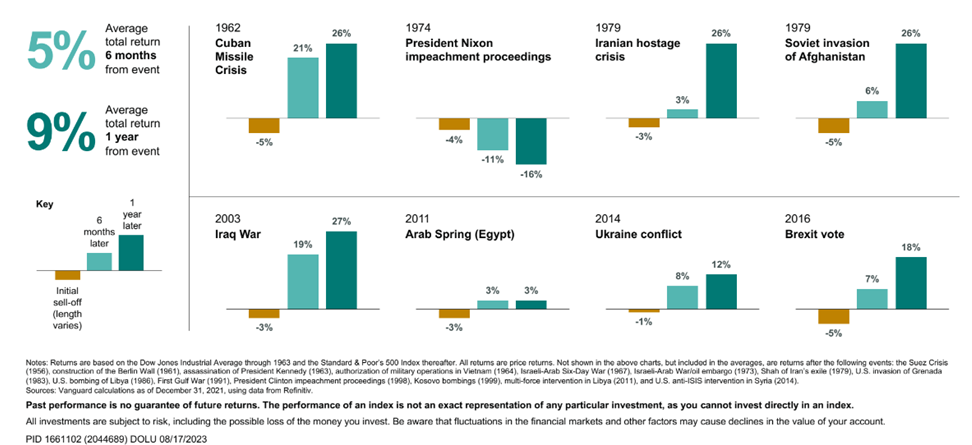
A new dimension of risk has entered the financial markets with heightened tensions in Ukraine. As you may have already seen through our weekly communications (if we manage your investments), there have been significant swings in sentiment reflected in financial markets, and the investment committee continues to monitor developments closely. It is worth reiterating though that we will maintain our long-term focus in the management of portfolios, and this means we will generally try to avoid being reactive to short-term volatility.

What history shows us

Why don’t we make snap decisions in environments like this? We know from historic events, that equity markets in the context of geopolitical risks are resilient and that sell-offs are typically short-lived:


Have a long term plan

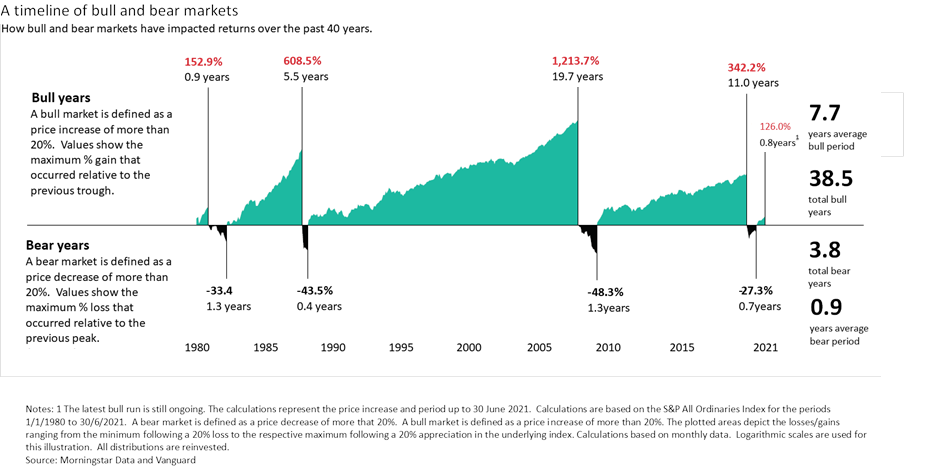
When we create your long term strategic plan (for our clients who have been through our financial planning process), we factor in downturns and bear markets. We focus on controlling the things that can be controlled to maximise your position and build strategies that can put you in the best possible position to meet your overall pre-and post-retirement goals.


Stay the Course

Now more than ever it is important to reinforce the need to lean into a few time-tested investment principles:
  1. Make compounding work for you,
  2. Stay the Course, and
  3. Avoid trying to pick next year’s winners. Focus on ensuring investments are well diversified as this will be a critical step in navigating a more tumultuous landscape going forward.

General Advice Warning

This information has been prepared and provided without taking into account your objectives, financial situation or needs. Before acting on this information, you should consider its appropriateness (having regard to your objectives, financial situation and needs) and any other information pertaining to your superannuation product by referring to its PDS.

Options available to you regarding your recent insurance premium increases


This communication is important and it will help you understand what you may be able to do about your insurance premium increases.

We are understandably being inundated with requests for assistance with premium increases and questions about Covid protection. We have written to you previously to explain the new insurance landscape and the government enforced changes that insurers must abide by. It has resulted in premium increases across the board from every insurer, not just yours and often in excess of 30%. To learn more about the changes insurers have been required to undertake, we have written this article that you may find useful to understand your increase when considering your insurance options.

Are you protected against illness or death related to Covid vaccinations or Covid itself?

In short, if you have retail advised insurance that has been underwritten, yes you are. Australian insurers registered with the Financial Services Council (FSC) code of practice and will honour Covid related claims. A list of the insurers can be found here as well as their media release guaranteeing Covid cover. Note that Industry Super Fund insurance ('group cover') can legally change the Terms and Conditions of policies retrospectively and may choose to limit cover as a result of Covid.

How can Equitem help you navigate premium increases?

We are keen to assist you to save money or to receive financial advice. The following are the ways we can assist you:
  1. If you want to solely to save money on your insurance premiums, you may instruct us to change your insurance policies to reduce your premiums, or
  2. If you require a full strategic review based on your or current financial situation and goals, you may request a new comprehensive financial plan from us where we will update your financial position, identify your objectives and needs, perform appropriate research and provide you with a new Statement of Advice. This process may not necessarily save you money and will incur additional fees as the purpose of such a review is to provide you with a new financial plan (note: it cannot be limited to insurance only advice).

How can you save money?

Changing aspects of your existing policies can result in significant premium savings. However any variation to your existing policies is a variation to the personal financial advice you received when you took out the insurance, therefore any changes may leave you underinsured and may not provide you or your family with the financial security you require upon the death, disability, illness or accident of yourself or loved ones.

Option 1: Reducing the Benefit Amount

Reducing the amount insured (the benefit amount you would receive if you were to make a claim) on any Life, TPD, Trauma or Income Protection policy will reduce your premiums. Each type of policy attracts its own premium. Reducing each/any of the premiums by a percentage will save you a similar percentage amount on that policy's premium (the exact saving will be calculated by your insurer).

Option 2: Remove the Extra Benefits Options

Some insurers offer Extra Benefits as additional cost options on their policies. Examples of such benefits include claim amounts increasing with CPI over the life of the claim, lump sum payments for specified injuries or illnesses (I.e. a broken shoulder), hospital benefits, partial income benefits, reduced waiting periods, Superannuation Guarantee payments or the ability to 'buy back' your cover after a claim to continue to be protected (please refer to your PDS for a full list of benefits). Turning off this option will save you money, but you will forego this extra protection.

Option 3: Extend your Waiting Period

Most Income Protection policies have a 30 day waiting period (the length of time you must be medically unable to work before your policy will commence paying you a replacement income). Extending the waiting period to 60 days, 90 days or 2 years can drastically reduce your premium. However you will have to be off work for longer periods of time and therefore you must ensure you can survive financially with lengthened waiting periods.

Option 4: Reduce your Benefit Period

Most Income Protection Policies pay your benefit to Age 65-67 (your anticipated retirement age based on your DOB). You could save money by reducing the Benefit Period to only 2 or 5 years. You must be aware however that if you make a claim, your insurer will cease paying your income replacement benefit after either 2 or 5 years. If you are still unable to work, no further payments will be made and you will be reliant on personal savings and/or potentially government disability benefits for an income.

Important Considerations:

  1. If you reduce your benefits and wish to add them back again in the future (I.e. you want to increase your cover again, add back benefits or reduce your waiting periods or switch insurers), you will be subject to new applications and medical underwriting, you will only be able to access the new style of insurance policies and you may not qualify for insurance.
  2. Making these changes may leave you in a detrimental financial position if you were to ever make a claim on one of your policies. Making these changes are 'self-directed', we will execute the changes for you, but unless you request a new comprehensive financial plan, we have not taken into account your current financial situation, the appropriateness of insurance, the claim outcome or the impact the changes you make will have to your personal and financial goals.
If you wish to make any of the above Optional changes to your policies please email clientservices@equitem.com.au with your requested changes. We will then contact your insurer and request a revised premium quote. Once we receive the quote from your insurer, we will send it to you for your consideration and decision. If you wish to implement the changes to save money, you must sign and date the quote and return it to us. We will process the change on your behalf with your insurer.

General Advice Warning

This information has been prepared and provided without taking into account your objectives, financial situation or needs. Before acting on this information, you should consider its appropriateness (having regard to your objectives, financial situation and needs) and any other information pertaining to your superannuation product by referring to its PDS.

Equitem’s 2021 in review


We have had an incredibly busy 2021 and are taking this opportunity to share you with a summary of our year:

What has been our most in-demand tasks of the year?

  • Working with clients aged 50+ to put strategies in place to maximise their position in preparation for retirement. Although retirement may not be on your radar, there are significant strategies to utilise now which can make a significant impact to your long term situation;
  • Assisting an increased number of clients with insurance claims;
  • Helping new and existing clients navigate their financial circumstances and put strategies in place to meet their goals and maximise their financial position. We have produced an increased number of debt reduction strategies, helped to identify cash flow and saving obstacles, tax minimisation, making additional contributions to superannuation, wealth investments, education investments and strategic planning;
  • Provided guidance on buying or selling a home to downsize or upsize based on life stages;
  • Assisted in the transitioning of UK pension assets to Australia;
  • Provided advice and strategies for inheritances received;
  • Winding up a number of SMSF’s.

Meeting the professional standards for financial advisers

We have been busy studying to achieve FASEA’s Education Standards. Elle and Brad met the FASEA accreditation requirements at the end of 2020, and have continued their post-graduate studies this year, fast-tracking toward exceeding the new Education requirements for Financial Planners.

The professional standards require financial advisers to:

  • Meet the new education requirements, a Degree Major or Post Grad in Financial Planning (back to university for most advisers, this is a great step but it has caused a lot of advisers to plan their exit from the industry);
  • Pass the financial adviser exam to test the practical application of their knowledge in key competency areas (completed by your Equitem advisers in 2020);
  • Participate in 40 hours of continuing professional development (CPD) per year to maintain and extend their professional capabilities, knowledge and skills, and
  • Comply with the Financial Planners and Advisers Code of Ethics – a set of principles and core values in the areas of ethical behaviour, client care, quality process and professional commitment
  • Anyone wanting to become a financial adviser must also complete a full-time professional year that includes at least 100 hours of structured training.

What does this mean?

  • While your Equitem advisers are already highly qualified, we are taking the opportunity to extend our qualifications with a Post Grad in Financial Planning. While this has consisted of long nights of study, Brad and Elle have been motivated and are enjoying the study semesters. They are looking forward to completing their studies in 2022, well ahead of the 2026 requirements.
  • The new requirements are targeted to moving the financial planning industry toward becoming a profession, giving you the peace of mind that all advisers adhere to requirements of an approved degree, ongoing training and professional standards as they similarly apply to Law, Medicine, CPA and Chartered Accountants as well as Engineers. Financial Planning will become Australia's 5th recognised profession.
  • In being recognised as a profession, we will "possess specialised knowledge and skills, education and training at a high level, and solely exercise these skills in the interest of others."
  • We are now obliged to take into consideration your overall financial circumstances before providing you with advice, this is a requirement of all financial advisers and we can no longer provide advice on your insurances in isolation.
  • While we have had to change the way we provide you with financial advice, we have had extremely positive feedback from clients who now have a full financial plan in place and strategies to maximise their positions, This is where the most value is achieved and we highly recommend that every individual or couple go through this process at least once.

Insurance changes

We have had a vast influx of enquiries with regards to insurances and premium increases, so what has been happening in the world of insurance?
  • Life insurance companies have not been profitable and ASIC mandated significant changes, requiring insurers to transform their products and offerings moving forward. Income Protection policies have been the most significantly impacted by the enforced changes, as well as premium increases across all insurers.
  • For clients who already hold an insurance policy, the changes have been grandfathered (protected).
  • For new policies or if you switch insurers, you are unlikely to receive the same comprehensive product as most insurers have reduced the benefits and increased premiums on the new style of policies available.
  • We always recommend that you review your personal insurance policies, but remember we are no longer legally able to provide you with advice without taking into consideration your overall circumstances. What does this mean? You will need to meet with your adviser and discuss your overall circumstances to allow them to provide you with holistic advice that has considered your short term and long term position, your adviser will provide you with a financial planning proposal outlining the advice that will be provided and the fees involved.
  • Financial planning is a highly valuable process that includes a plan toward self-insurance and/or reducing your insurance premiums over time as you reach financial milestones.

In case you missed it:

  • Mike Callanan semi-retired in June, and resigned his Financial Adviser License in May, however, he will not be leaving the business and will continue to focus on running group insurance and insurance claims for the foreseeable future.
  • Elle Ross is now a director of Equitem alongside existing directors Bradley Ellison and David Palfrey. Elle has been employed with Equitem as a Senior Financial Adviser for over 5 years and has been advising clients since 2013. With 15 years of experience in financial services, Elle continues to receive consistent recognition for her contribution to the industry.
  • At the end of 2020, and after a rigorous vetting process through ASIC, Equitem received its own Australian Financial Services License (AFSL). Our own license allows us direct control and flexibility over how we run our business and offer our services, providing greater choice in which providers we choose to use and importantly improved outcomes for you.
  • Amé has continued her University studies in Marketing. The many changes you have, and will continue to see, have been driven by Ame’ bringing an exceptional approach to her client services role. Amé continues to be a valuable client services manager to Brad, Elle and all clients.

We want to take this opportunity to wish you all a Merry Christmas and a safe and prosperous 2022. We are looking forward to continuing to work with you and assisting you with your overall financial planning needs.


General Advice Warning

This information has been prepared and provided without taking into account your objectives, financial situation or needs. Before acting on this information, you should consider its appropriateness (having regard to your objectives, financial situation and needs) and any other information pertaining to your superannuation product by referring to its PDS.